


| Program Type | Workshop | Residency |
| Art Form | Visual Arts |
| Curriculum Connections | Social Studies | STEM |
| Target Grades | Pre-K | K | 1 | 2 | 3 | 4 | 5 | 6 | 7 | 8 | 9 | 10 | 11 | 12 | Adult | Families |

View Artist & Programs
Testimonial
"Susan Striker has topped herself" Horizon Monthly
"….chockfull of ideas to stretch youngster's imaginations" St. Paul Dispatch
"Revolutionary…Extraordinary" Newsweek
"What a wonderfully creative tool" The Cleveland Plain dealer
"….chockfull of ideas to stretch youngster's imaginations" St. Paul Dispatch
"Revolutionary…Extraordinary" Newsweek
"What a wonderfully creative tool" The Cleveland Plain dealer
Description
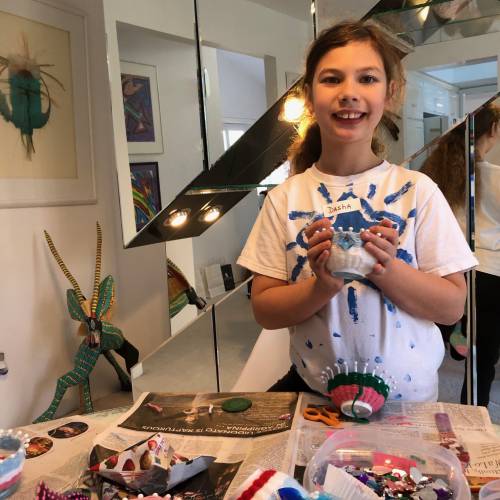
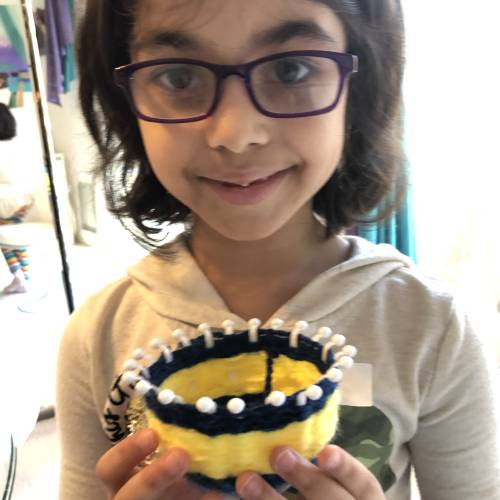
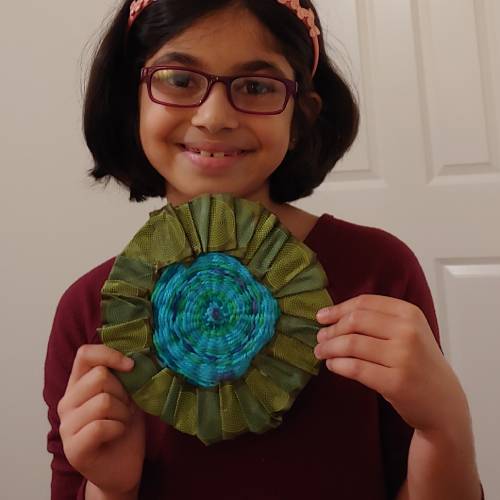
We begin with the dramatic reading of a storybook about making a basket, followed by viewing illustrations that will inspire interest in weaving. Award-winning art educator Susan Striker will offer a wide variety of samples to view and examine, which will inspire student's basket making experience.
Objectives
• Fine motor skills: Weaving strengthens hand muscles, finger dexterity, and hand-eye coordination as children thread materials in a variety of sequences, including the basic over and under.
• Pattern recognition: Following an over-under variety of sequences helps children recognize, create, and predict patterns—an early math skill.
• Problem-solving: Children learn to fix mistakes, adjust their work, and think critically when materials become tangled or uneven.
• Concentration and patience: Weaving requires focus and persistence, helping children build attention span and resilience.
• Creativity: They choose colors, textures, and designs, encouraging artistic expression and imagination.
• Spatial awareness: Children gain an understanding of how pieces fit together and how changing one part affects the overall design.
• Planning and sequencing: Weaving involves following steps in a specific order, an important executive functioning skill.
• Pattern recognition: Following an over-under variety of sequences helps children recognize, create, and predict patterns—an early math skill.
• Problem-solving: Children learn to fix mistakes, adjust their work, and think critically when materials become tangled or uneven.
• Concentration and patience: Weaving requires focus and persistence, helping children build attention span and resilience.
• Creativity: They choose colors, textures, and designs, encouraging artistic expression and imagination.
• Spatial awareness: Children gain an understanding of how pieces fit together and how changing one part affects the overall design.
• Planning and sequencing: Weaving involves following steps in a specific order, an important executive functioning skill.
Pricing Information
$480 for a single workshop
$765 for back-to-back workshops
$1,433 for 1 day (4 workshops, 90 minutes per workshop)
$3,825 for 3 days (4 workshops, 90 minutes per workshop)
$5,535 for 5 days (4 workshops, 90 minutes per workshop)
There is an additional $ 2.00-per-child materials fee.
$765 for back-to-back workshops
$1,433 for 1 day (4 workshops, 90 minutes per workshop)
$3,825 for 3 days (4 workshops, 90 minutes per workshop)
$5,535 for 5 days (4 workshops, 90 minutes per workshop)
There is an additional $ 2.00-per-child materials fee.
Video
Program Length
60 - 90 minutes. Programs are designed to meet the interest level and weaving experience of the students. 60 minutes per class is ideal.
Participants
Approximately 25 in a live class, more in virtual format.
Technical Specifications
• Set Up: 30 minutes
• Break: Once I set up the materials and display examples of finished weavings, it would be great, but not essential, for me to stay there. I also would be able to move from room to room and set up each time.
• Strike: 30 minutes
• Program Space: We can sit at tables or on the floor. I like to have a table to display the wide variety of materials that each participant may choose to use. Water is not necessary.
• Electricity/Wi-Fi: Not necessary.
• Audiovisual/Tech: Not necessary.
• Tables/Chairs: Ideally we can use tables and chairs.
• Dressing Room: Not necessary.
• Outside Possible: Sitting outside in good weather would be delightful on a blanket or rug. We would be sitting on the ground for a dramatic reading of a storybook and could easily stay in place as we begin weaving.
• Venue-Provided Supplies: The venue does not need to supply anything except a broom and dustpan that I can use to sweep up the yarn scraps at the end of the presentation.
• Mobility/Location Needs: I can move from classroom to classroom for each workshop. I can carry all of the required materials and stairs would be no problem.
• Break: Once I set up the materials and display examples of finished weavings, it would be great, but not essential, for me to stay there. I also would be able to move from room to room and set up each time.
• Strike: 30 minutes
• Program Space: We can sit at tables or on the floor. I like to have a table to display the wide variety of materials that each participant may choose to use. Water is not necessary.
• Electricity/Wi-Fi: Not necessary.
• Audiovisual/Tech: Not necessary.
• Tables/Chairs: Ideally we can use tables and chairs.
• Dressing Room: Not necessary.
• Outside Possible: Sitting outside in good weather would be delightful on a blanket or rug. We would be sitting on the ground for a dramatic reading of a storybook and could easily stay in place as we begin weaving.
• Venue-Provided Supplies: The venue does not need to supply anything except a broom and dustpan that I can use to sweep up the yarn scraps at the end of the presentation.
• Mobility/Location Needs: I can move from classroom to classroom for each workshop. I can carry all of the required materials and stairs would be no problem.